
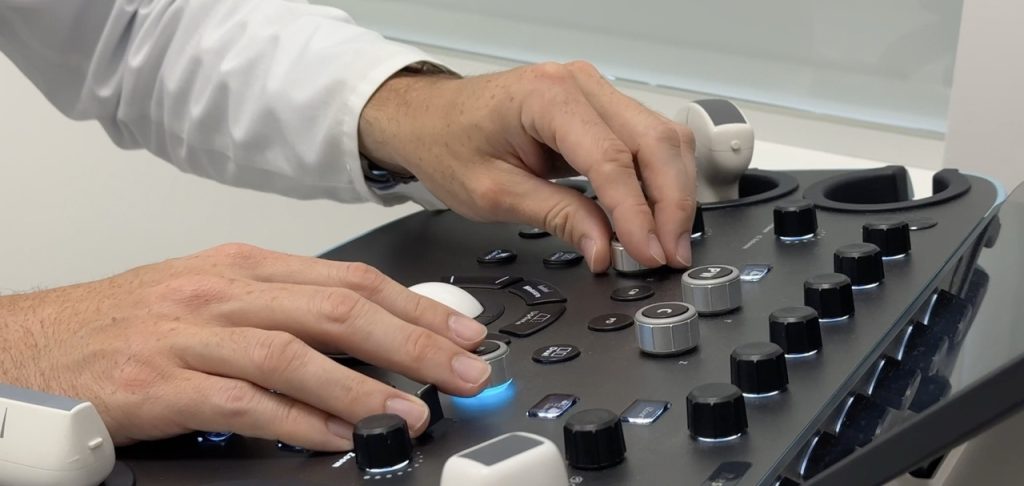
An ultrasound scan for a multiple pregnancy is an imaging examination based on the reflection of different types of sound waves from tissues of varying densities, which allows the condition and growth of each foetus, as well as the overall progress of the pregnancy, to be assessed. Ultrasound scans are safe and can be carried out throughout the pregnancy.
When should an ultrasound scan be carried out during pregnancy?
- To confirm a multiple pregnancy;
- To determine the number of foetuses;
- To assess whether the foetuses share a placenta and/or amniotic fluid;
- To monitor the growth and development of each foetus;
- To assess heart function and movements;
- To identify any differences in growth between the foetuses;
- To assess the condition and position of the placenta;
- To monitor the volume of amniotic fluid;
- To assess the position of the babies in the womb;
- To detect potential complications at an early stage.
How many ultrasound scans are carried out during a multiple pregnancy?
Ultrasound scans are carried out more frequently during a multiple pregnancy – usually every 4 weeks, and even more frequently in high-risk cases. The frequency of scans depends on:
- The condition of the foetuses;
- The type of pregnancy (whether the foetuses share a placenta);
- The risk of potential complications.
When is the first ultrasound scan carried out during pregnancy?
The first ultrasound scan is usually carried out in the early stages of pregnancy, around 6–8 weeks. Obstetricians and gynaecologists carry out the early ultrasound scan transvaginally (transvaginal ultrasound scan). During the scan:
- Pregnancy is confirmed;
- The number of foetuses is determined;
- Their position in the womb is assessed;
- It is determined whether the pregnancy involves a single or multiple placentas;
- The viability of the foetuses is assessed.
During subsequent ultrasound scans, the doctor:
- Assesses the growth of each foetus;
- Compares the sizes of the foetuses;
- Assesses organ development;
- Assesses blood flow;
- Identifies any potential complications;
- Assesses the position of the foetuses prior to delivery.
What types of ultrasound scans are there during a multiple pregnancy?
- Transvaginal ultrasound (via the vagina) – in the early stages of pregnancy, this scan helps to detect the foetal heartbeat or determine how far along you are in your pregnancy.
- Transabdominal (through the abdominal wall) ultrasound – this scan is used from around 12 weeks of pregnancy.
- Doppler ultrasound – this scan checks how your baby’s blood flows through the blood vessels;
- Foetal echocardiogram – this examination assesses the size, shape, function and structure of your baby’s heart.
How should you prepare for an ultrasound scan during pregnancy?
No special preparation is required for this examination.
What happens during an ultrasound scan?
During a pregnancy ultrasound scan, you will need to undress from the waist down and lie down on the examination table. The doctor will help you get into the most comfortable position and, using a clear, water-based gel, will begin the scan through the abdominal wall using a transducer, which will display all the images on the ultrasound screen. The doctor may save the images and print them out if necessary. A pregnancy ultrasound scan usually takes around 15–30 minutes.
What happens after the scan?
Once the pregnancy ultrasound has been completed, the doctor will review and interpret the images again; all the information will be saved on the e-health portal. After assessing the ultrasound findings, the doctor will let you know whether you need any further tests, procedures or treatment.
When will you find out the results?
You should be given the results of the ultrasound scan at the end of your appointment.
Are there any risks or restrictions associated with an ultrasound scan during pregnancy?
An ultrasound scan is based on the reflection of sound waves from tissues of varying density, so there is no exposure to radiation. Studies have shown that ultrasound scans are safe during pregnancy. There are no harmful side effects for you or your baby.
Multiple fetal ultrasound
85 €